
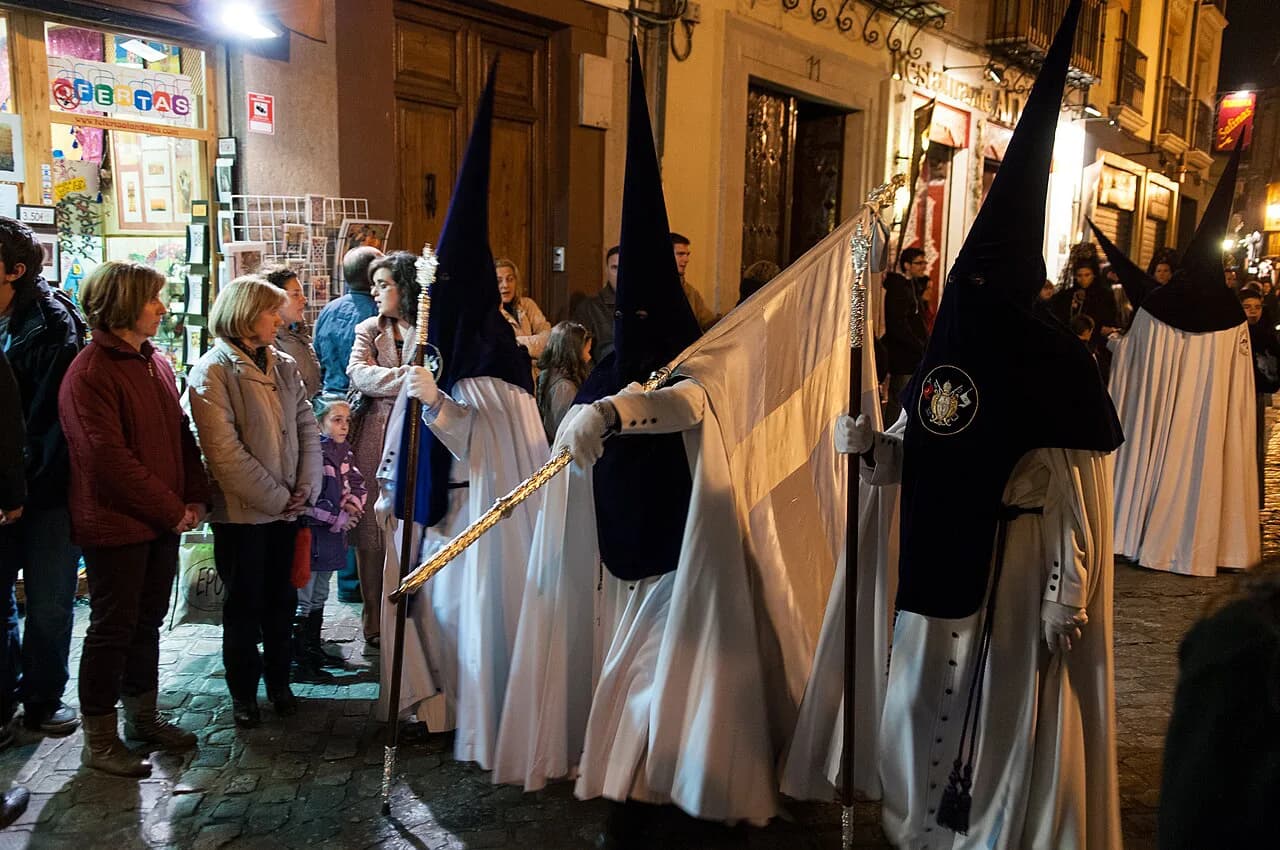
Last updated August 2026. Semana Santa Zamora runs March 29 through April 5, 2026, and trades Andalusian spectacle for silence, barefoot penitents, and darkened Romanesque streets. This guide ranks the seven processions, sites, and rituals that define Zamora's Holy Week, plus where to stand, what to eat, and when to book.
Semana Santa Zamora 2026: Quick Facts and the Zamora Difference
Zamora is known for its Romanesque churches, and Holy Week processions move through and past them on narrow medieval streets. Today's celebration includes 18 separate processions built around 53 individual pasos, according to the Junta Pro Semana Santa de Zamora. Compare that to Andalusia's Semana Santa, where brass bands, flowers, and applause define Seville and Málaga. Hooded penitents walk in near-total silence instead, streetlights dim along the route, and crowds are asked not to speak. The result sits closer to the sober, Castilian tone of Semana Santa in Valladolid than to anything in the south, though Zamora pushes the austerity further. Provincial tourism officials also track related Passion traditions in Toro, Benavente, Bercianos de Aliste, Fuentesaúco, and Villalpando for travelers planning a longer stay.
- 2026 dates
- Semana Santa Zamora runs from Palm Sunday to Easter Sunday, March 29 through April 5, 2026.
- Scale
- Sixteen hermandades and cofradías organize the week, staging 18 processions and 53 individual pasos in total.
- Official status
- The week holds Spain's Fiesta de Interés Turístico Internacional designation and, since 2015, Bien de Interés Cultural status.
A Brief History of Zamora's Holy Week
Documented references to Zamora's Passion processions trace back to 1179, when Infante Don Sancho granted the cathedral chapter formal rights to process on Palm Sunday. Some accounts date its roots to 1273, placing it among Spain's oldest Holy Week traditions. Founded in the 15th century, the Cofradía de la Santa Vera Cruz ranks among the country's oldest processional confraternities still active today. Sculptor Ramón Álvarez, born in nearby Coreses, worked through the 19th century and contributed many of the pasos still carried through the streets. Zamora's tourism-focused Junta de Fomento formed in 1897, and it eventually became today's Junta Pro Semana Santa, the body that now coordinates all 16 hermandades and cofradías.
Since 1964, the Museo de Semana Santa has preserved the pasos that still move through Zamora's medieval streets, a preservation that echoes the institutional care beginning with the 1897 Junta de Fomento and continuing through official international designation.
7 Best Semana Santa Zamora Processions and Traditions
These seven processions, sites, and rituals give the clearest picture of what makes Semana Santa Zamora distinct. Use them to build a realistic day-by-day viewing plan.
- El Silencio – Real Hermandad del Santísimo Cristo de las Injurias (Wednesday)
- On Holy Wednesday, roughly 2,300 members of this brotherhood swear an oath of silence in the Plaza de la Catedral before processing.
- Streetlights along the route are dimmed, and spectators are asked not to speak until the procession passes.
- Founded in 1925, it remains the clearest expression of Zamora's austere reputation.
- Capas Pardas – Hermandad Penitencial del Santísimo Cristo del Amparo (Wednesday night)
- Around 150 penitents wear the brown Alistana wool cloaks, or capas pardas, that give the brotherhood its name.
- A single bombardino plays as the procession moves, and lanterns provide the only light.
- Founded in 1956, it carries the rural Aliste region's identity into the city center.
- La Congregación / Cinco de Copas (Good Friday, dawn)
- Around 4,900 members process from before dawn on Good Friday, one of the week's largest turnouts.
- Two brothers known as the Merlú wake the city with trumpet and drum near 5:00 a.m. to summon the brotherhood.
- Locals call the group Cinco de Copas after its five main scenes, and its reverence to the Virgen de la Soledad on Tres Cruces Avenue draws applause.
- Museo de Semana Santa
- The museum has displayed Zamora's processional pasos year-round since it opened in 1964, letting visitors examine the sculptures up close without a crowd.
- Look for work by Ramón Álvarez, the 19th-century sculptor from nearby Coreses, and by Mariano Benlliure.
- Check current opening hours and accessibility details before you go, since they can shift around the holiday.
- Bercianos de Aliste: The Capa de Honras Procession
- This rural village, also recognized as a Bien de Interés Cultural, holds a funeral-style procession built around silence and slow, deliberate steps.
- Its signature garment is the Capa de Honras, a heavy brown wool cloak worn across the wider Aliste, Alba, and Tras os Montes region.
- Its atmosphere differs sharply from anything inside Zamora's city walls, and reaching it requires a car since it sits outside the city's public transit network.
- Plaza de la Catedral and Puente de Piedra: Where to Watch
- Plaza de la Catedral offers the closest vantage point to El Silencio's oath, but space fills fast and stillness is expected.
- Puente de Piedra, the stone bridge over the Duero, offers a wider angle and more room to move for photography.
- Streetlights are dimmed during night processions, so bring a fast lens or a tripod rather than flash, which disrupts the ritual.
- Sopa de Ajo, Dos y Pingada, and Aceitunada: The Holy Week Table
- Bakeries and bars serve sopa de ajo, a garlic soup, at dawn on Good Friday to warm up early risers heading to La Congregación.
- Dos y Pingada, fried eggs with cured ham, is the traditional plate on Easter Sunday once the fasting mood lifts.
- Aceitunada, an olive-oil sweet bread, rounds out the week's food traditions alongside both dishes.
Silent Night vs Daylight Grandeur: Which Processions to Prioritize
Zamora's processions split into two distinct moods, and deciding which to prioritize shapes the rest of your schedule. Night processions reward patience and quiet. Daylight processions reward arriving early for a clear sightline.
| Type | Example Processions | Atmosphere | Best For |
|---|---|---|---|
| Silent Night | El Silencio (Wed), Capas Pardas (Wed night), Jesús Yacente (Holy Thursday night) | Torchlight, near-total silence, funeral marches | Photographers and first-time visitors who want Zamora's defining experience |
| Daylight Grandeur | La Borriquita (Palm Sunday), La Congregación (Good Friday morning), Santo Entierro (Good Friday evening) | Marching bands, applause at key moments, larger crowds | Families and visitors who prefer a shorter time commitment |
Regional Variations Beyond Zamora: Toro, Benavente, and the Holy Week Circuit
Zamora city isn't the only place in the province marking Holy Week. Several nearby towns are worth a detour if you're staying more than a few days. Toro combines processions with a monumental old town and notable sculptural pasos of its own. Benavente follows a similarly restrained, silent register, closer to Zamora's tone than to Aliste's rural style. Fuentesaúco and Villalpando also hold Fiesta de Interés Turístico Regional status, and Villalpando alone stages as many as nine separate processional cortejos, according to regional tourism sources. Travelers building a longer Holy Week circuit across Spain often add Cuenca next. Semana Santa in Cuenca is built around dramatic hanging crosses, documented by the Junta de Cofradías de Cuenca, and offers a visual style completely different from Zamora's austerity.
Planning Your Visit: Timing, Viewing Spots, and Where to Stay
Tuesday and Wednesday give the best balance of major processions and manageable crowds, since the heaviest visitor numbers concentrate on Good Friday and Easter weekend. Arriving a day or two before Palm Sunday lets you scout the route before the crowds build. Plaza de la Catedral offers the closest vantage point to El Silencio's oath, but expect to claim a spot at least an hour early and to stand for the duration. Plaza Mayor trades some atmosphere for more breathing room, and it works better if you're traveling with kids or need to step away partway through. Each year, the Junta Pro Semana Santa and Caja Rural distribute roughly 30,000 free itinerary maps around the city. Picking one up on arrival beats tracking routes on a phone in a crowd. Hotels inside Zamora's old town routinely sell out six to twelve months ahead of Holy Week, so book as soon as your dates are fixed. If nothing is left, Salamanca is a practical fallback base, and rural casas rurales around the province also fill the gap for travelers who don't mind a short drive in.
Tracing back to 1179, Zamora's processions rank among Spain's oldest documented Holy Week traditions, creating an austere Castilian character that sharply contrasts with the brass bands and floral displays of southern celebrations.
- Tuesday: Arrive and Scout
- Check into your accommodation, walk the Plaza de la Catedral and Plaza Mayor routes in daylight, and pick up a free itinerary map.
- Wednesday: The Big Three
- Watch the Cristo de las Injurias oath of silence in the afternoon, then the Capas Pardas after dark for the week's most concentrated day of processions.
- Good Friday: Dawn to Dusk
- Set an alarm before 5:00 a.m. for the Merlú and La Congregación, then return in the evening for the Santo Entierro.
- Easter Sunday: Slow Down
- Expect a lighter, more celebratory register, and close the week with Dos y Pingada before the Santísima Resurrección procession.
What's Free, Ticketed, or Requires a Car
Budgeting for Semana Santa Zamora is mostly about time, not money, since almost every procession is free to watch from the street. A handful of experiences carry a cost or logistical trade-off worth planning around. As of 2026, Turismo de Zamora lists current museum hours and any entry fee, since both can change year to year.
| Experience | Cost | Access |
|---|---|---|
| 16 street processions | Free | Public streets across Zamora; no ticket needed |
| Museo de Semana Santa | Ticketed entry | Check current pricing and hours before you go |
| Bercianos de Aliste (Capa de Honras) | Free to watch | Requires a car; no direct public transit from Zamora |
| Toro, Benavente, Fuentesaúco, and Villalpando processions | Free to watch | Requires a car or a regional bus for a day trip |
Photography Tips for Zamora's Dimmed Streetlights
Camera settings matter as much as timing during Semana Santa Zamora, since organizers dim public lighting along most processional routes. A few adjustments make the difference between a blurred frame and a usable one.
- Shoot from Puente de Piedra
- The stone bridge over the Duero gives a wide angle across the route and the cathedral skyline together, which works well for long-exposure night shots.
- Skip flash entirely
- Streetlights are dimmed on purpose, and a flash breaks both the mood and the shot. Raise ISO or bring a tripod instead.
- Time Good Friday for the Merlú
- Arriving near 5:00 a.m. catches La Congregación's trumpet-and-drum call to the brotherhood before the crowds build.
- Study the national photography competition
- The Junta Pro Semana Santa's annual national photography contest, now in its 42nd edition, exhibits winning entries that map out reliable angles before you commit to one.
The Sounds of Zamora's Holy Week
Sound carries as much meaning as sight during Semana Santa Zamora. A Barandal, the bell ringer who walks with each brotherhood, breaks the silence at set points along the route with a single bell. The funeral march composed by Thalberg is performed so often across the week that locals treat it as the city's unofficial anthem. In 2026, the Diputación de Zamora built its promotional campaign, 'Zamora, Escúchate,' entirely around this soundscape, from muffled drums to the single bombardino accompanying the Capas Pardas. Away from the processions themselves, the Junta Pro Semana Santa de Zamora also runs an annual national photography competition. Its exhibited entries are a good way to preview the week's key visual moments before you arrive.
Mistakes to Avoid and Semana Santa Zamora Etiquette
Several avoidable mistakes separate a frustrating visit from a smooth one. A cofradía or hermandad is a brotherhood, and a paso is a sculpture group carried through the streets. Caperuzo describes the tall conical hood worn by a penitente, the individual brother taking part. Skipping flash photography matters most during night processions, since a single bright flash breaks the mood for everyone nearby and can draw a sharp response from stewards. Pack real layers rather than a light jacket, since Zamora's wind is a known local hazard even when the daytime temperature looks mild on paper. Treat Plaza Mayor as a trap if you arrive ten minutes before a procession is due. By then every viewing line is already full, so aim to be in position closer to an hour ahead for any of the week's marquee events. Don't assume every procession runs on southern Spain's timeline. Some of Zamora's most anticipated moments happen well before sunrise or after midnight, so check the official calendar before setting an alarm. Keep conversation to a minimum near El Silencio and the other night processions, since the oath of silence is not a suggestion. It's the point.
Frequently Asked Questions
When is Semana Santa Zamora in 2026?
Semana Santa Zamora runs from March 29 through April 5, 2026, covering Palm Sunday through Easter Sunday. Wednesday and Good Friday carry the week's most significant processions.
What makes Zamora's Holy Week different from Seville or Málaga?
Zamora favors silence, dim streetlights, and Romanesque backdrops over brass bands and flower-draped floats. Crowds are asked not to speak during processions like El Silencio, and that restraint is the city's defining trait.
Do you need tickets for the processions?
Nearly every procession is free to watch from public streets across Zamora. Only the Museo de Semana Santa charges an entry fee, and Turismo de Zamora lists current hours and pricing.
Is Bercianos de Aliste worth a day trip during Holy Week?
Yes, if slow, rural tradition interests you more than a second city procession. Its Capa de Honras procession is austere and funeral-paced, and it requires a car since no direct public transit runs from Zamora.
What should you wear to Semana Santa Zamora?
Pack real layers rather than a single coat, since Zamora's wind can cut through light jackets even on a mild afternoon. Comfortable, closed shoes matter too, given the hours spent standing on cobblestone streets.
Can you combine Zamora with other Holy Week destinations in Spain?
Yes. Many travelers pair Zamora's silence with contrasting styles elsewhere. Semana Santa in Valladolid offers a related but more monumental Castilian tone. Semana Santa in Cuenca centers on a completely different visual, built around dramatic hanging crosses.
Holy Week Beyond Seville
Three very different Semana Santas in inland Spain.