Last updated July 2026. Semana Santa Seville fills the historic center with processions of Baroque floats, incense smoke, and silent crowds for eight straight days. Easter falls on the first Sunday after the first full moon of spring, so the week never lands on the same calendar dates twice. This guide breaks down the Madrugá, the trade-off between a rented balcony and a street-side spot, and the etiquette that keeps a first Holy Week from turning into a logistics headache.
What Is Semana Santa Seville?
Semana Santa Seville is Seville's Holy Week, eight days of processions between Palm Sunday and Easter Sunday organized by the city's Catholic brotherhoods. Official sources count nearly 70 brotherhoods and around 50,000 participating nazarenos moving through the city in a single week, with more than a hundred processional floats taking part in total. Some suburban processions spend up to 14 hours between leaving their home church and returning to it. Spain has recognized Holy Week in Seville as a Festival of International Tourist Interest since 1980. Incense, beeswax, and orange blossom make up the week's signature smell, as much a part of the experience as the floats themselves. It sits inside Spain's annual festival calendar as one of Seville's two defining annual events. The other is Seville's April Fair, which follows about two weeks later with a completely different mood. Where Semana Santa is solemn and quiet, Feria de Abril is loud, bright, and built around dancing rather than penance. Andalusia's carnival season runs earlier in the year, before Lent begins. Cadiz's carnival is one of the region's biggest. Tenerife's carnival, in the Canary Islands, is another major one held around the same time of year.
With around 50,000 participating nazarenos, official Carrera Oficial seating is virtually unavailable. Most visitors choose between free street viewing and paid balconies, each with distinct trade-offs in cost and comfort.
The Anatomy of a Procession: Pasos, Nazarenos, and Music
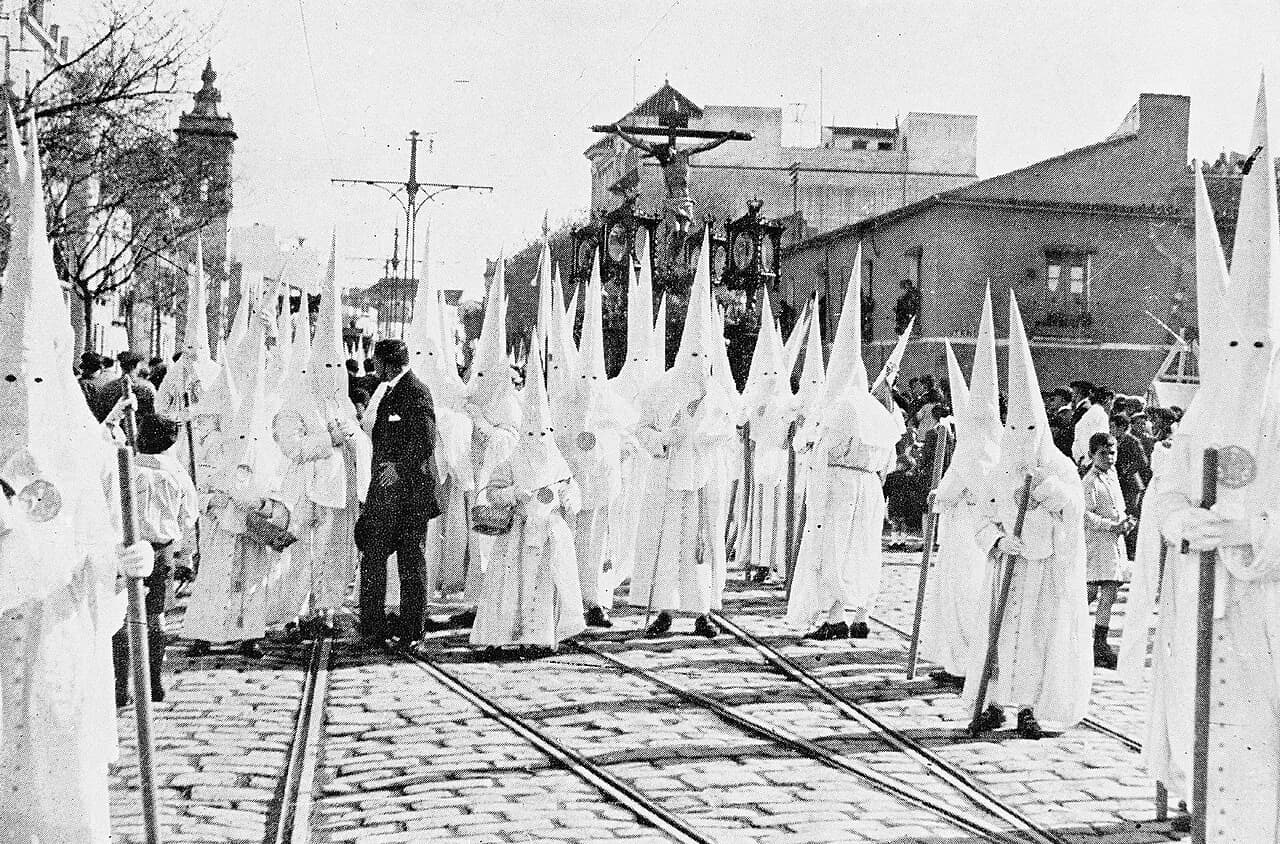
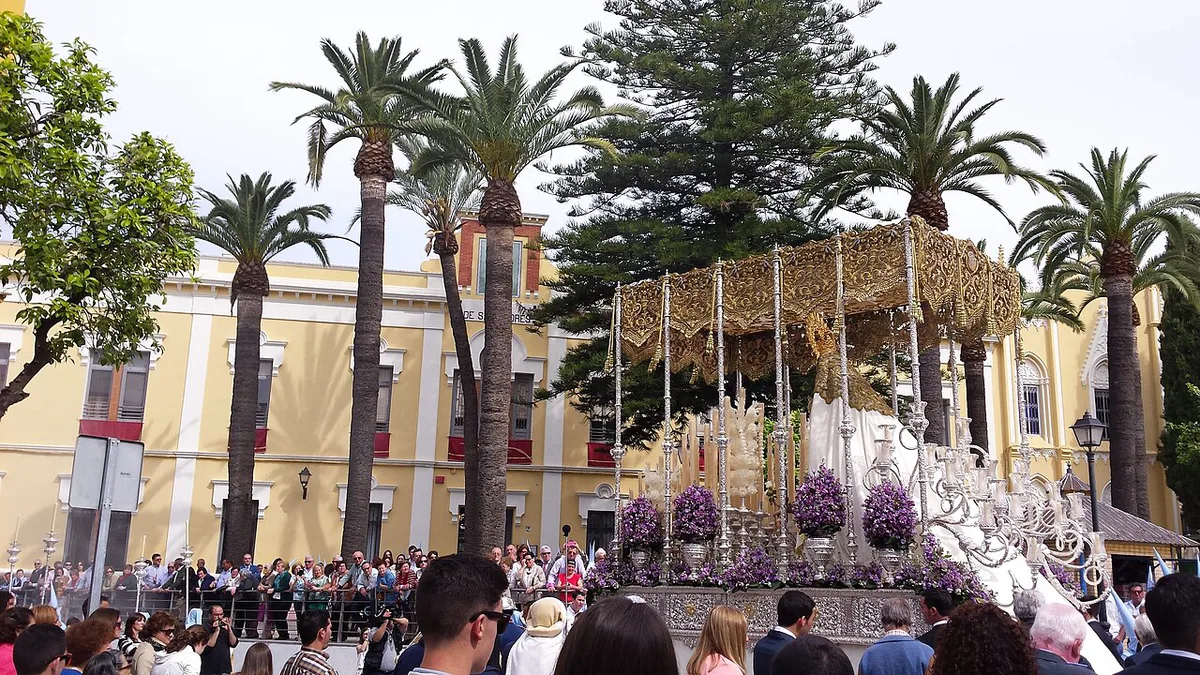
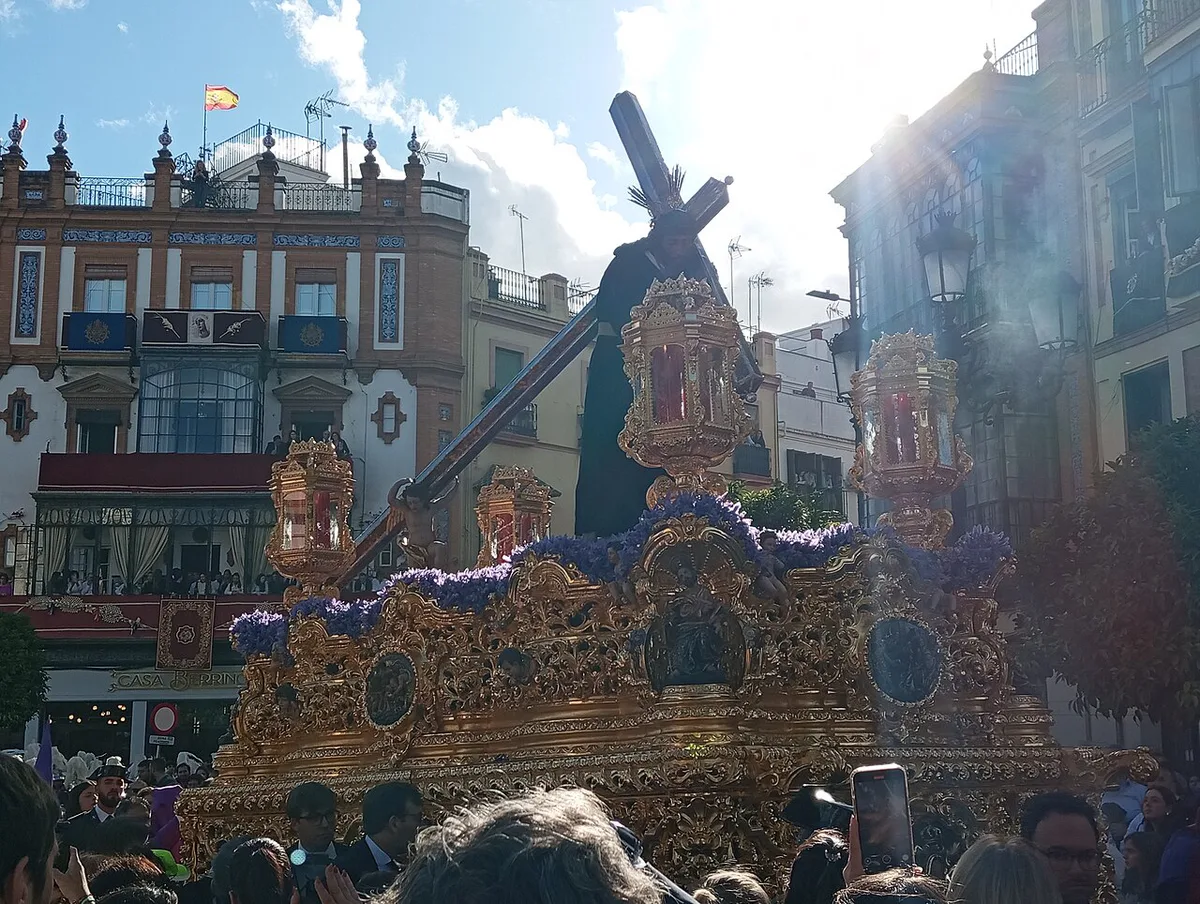
Each procession, called an estación de penitencia, centers on one to three pasos, the wooden floats carried through the streets. Floats depicting Christ are typically covered in gold leaf. Those honoring the Virgin Mary usually travel under a silver canopy instead. Underneath each float, hidden teams of costaleros carry the weight on their necks and shoulders. Wikipedia records that a single paso needs between 24 and 54 costaleros, since most weigh well over £2,200. An overseer called a capataz directs the costaleros with a ceremonial hammer, the llamador, since the men inside can't see the street. Ahead of each float march the nazarenos, robed penitents wearing the pointed hood called a capirote. The shape has led some first-time visitors to associate it with the Ku Klux Klan, but the two are unrelated. Seville's brotherhoods use the capirote as a centuries-old device for anonymous penance, not intimidation. A smaller group known as penitentes marches too, carrying wooden crosses as public penance; unlike the nazarenos, they walk without the pointed hood. Robes fall into two main styles. Cape robes belong to brotherhoods whose nazarenos may hand out sweets or candle wax to children along the route. Tail robes, often made of black fabric, belong to more austere brotherhoods whose members walk in total silence. Music marks a real difference between processions, too. Christ's floats usually move behind bands of cornets and drums. Virgin Mary floats typically travel with fuller music bands instead. A handful of brotherhoods process in complete silence, known locally as serious brotherhoods, with no music at all. From balconies along the route, spectators sometimes break into a saeta, an unaccompanied flamenco lament sung directly at a passing image.
The Holy Week Calendar: Day by Day
Seville's official tourism board and Spain's national tourism site both list the next edition for March 21 to March 28, 2027. That date comes from the lunar Easter calculation, not a fixed spot on the calendar. Easter Sunday always falls somewhere between March 22 and April 25, which is why the exact week can move by as much as five weeks from one year to the next. The most recent edition ran March 29 to April 5, 2026. Confirm exact daily procession schedules closer to the date, since brotherhoods typically finalize routes and times only a few months out. Palm Sunday opens Holy Week with the heaviest crowds of the entire week, since most first-time visitors arrive on the same day. Processions begin in the mid-afternoon and continue into the early hours of Monday. Holy Monday through Holy Wednesday draw noticeably thinner crowds, since these days are traditionally attended more by residents than visitors. Even so, thinner still means dense by most cities' standards. Holy Thursday brings the mantilla into view. Women across the city wear the traditional black lace veil and comb as a mark of mourning and respect. The Madrugá, the stretch from midnight Holy Thursday into the morning of Good Friday, is Holy Week's best-known and busiest window. It carries three of the city's most venerated images: La Macarena, Jesús del Gran Poder, and the Esperanza de Triana. Some of these processions run up to 14 hours between leaving their home church and returning. Easter Sunday closes the week on a lighter note. Processions end near Seville Cathedral in a more celebratory mood than the rest of the week.
Some processions run up to 14 hours, and combined with cobblestone streets, proper footwear isn't a style choice—it's a survival requirement. Underestimating physical endurance is a classic first-timer mistake.
| Daytime processions (Palm Sunday-Wednesday) | La Madrugá (Thursday night-Friday morning) | |
|---|---|---|
| Mood | Lighter, family-friendly | Solemn, intense |
| Best for | First visits, children | Photography, seasoned visitors |
| Crowd level | Heaviest on Palm Sunday, lighter midweek | Densest crowds of the week |
| Time on the street | Roughly 4 to 8 hours per brotherhood | Up to 14 hours for some brotherhoods |
How to Actually See the Processions
Every procession's final stretch is a shared route called the Carrera Oficial, which runs from Plaza de la Campana to Seville Cathedral. This shared finish, called the Estación de Penitencia, is the central goal of each brotherhood's day. Seating along the Carrera Oficial is organized entirely by the Consejo Superior de Hermandades y Cofradías, the official body overseeing Seville's brotherhoods. Many of those chairs are inherited within Sevillian families or booked years ahead. Realistically, plan to watch from somewhere off the Carrera Oficial instead. Two main strategies work for most visitors. A rented balcony overlooking the route gives a fixed, elevated view with a bathroom and food close at hand. Local balcony operators list the streets around the Giralda and the Cathedral as their most requested spots. The trade-off is cost and a fixed vantage point for the night. Street viewing costs nothing and lets you move between two or three processions in one evening. It also means standing for hours in a dense crowd with no guaranteed sightline. To follow the street strategy well, use a printed programa de mano or a Holy Week app. Track each brotherhood's Cruz de Guía, the ceremonial cross that leads every procession. Position yourself where a procession leaves its home church, in a neighborhood like Triana or San Bernardo. That vantage gives a smaller, more emotional scene than the crowds waiting at the Cathedral.
Local Etiquette and Survival Tips
Dress in Seville during Holy Week leans formal. Ripped jeans, flip-flops, and beachwear stand out against a crowd largely dressed in what Sevillians consider their best clothes. Aim for a comfortable middle ground instead of full formalwear or beach casual. Families dominate the crowds along most routes, dressed up together for the occasion. Crossing a procession's line is safe only when the float and its nazarenos are stationary, never while they are moving. Watch for a natural pause in the line, then cross quickly and clear the street. When uncertain, wait and follow the lead of a local doing the same. Food carries its own rhythm through the week. Torrijas, milk- or wine-soaked bread that's fried and finished with honey or sugar, and pestiños, honey-glazed fried pastries, are the two Lenten sweets to look for across the city. Bars near brotherhood churches, sometimes called cofrade bars, fill with costaleros and nazarenos between procession legs and offer a more local read on the week than the crowds along the main routes.
- Closed, comfortable shoes for cobblestones and hours of standing
- Real trousers or a dress rather than shorts or leggings
- A light jacket for cooler evening processions
Costs, Accommodation, and Getting Around
Budget for Semana Santa Seville depends almost entirely on how you choose to watch. Street viewing costs nothing beyond food and a place to sleep. A rented balcony seat is the premium option, typically running €200 to €500 or more per seat depending on the day, procession, and view. Follow the three-month rule for booking a place to stay. Rooms inside or near the historic center often become scarce inside three months of Palm Sunday, and prices climb the closer you get to the date. Seville's center becomes largely pedestrian during procession hours, since the routes close as each brotherhood passes through. Plan to arrive by Metro or on foot from the edges of downtown, such as San Bernardo or Plaza de Armas, rather than relying on a car or taxi to reach the center directly. Arrive early at any spot you want along a route, since the busiest stretches fill in fast. Semana Santa is only one entry on Spain's busy festival year, and some travelers build it into a longer spring trip. Las Fallas in Valencia is one alternative with a completely different atmosphere. San Fermín in Pamplona is another, built around an entirely different tradition. La Tomatina 2026: The Complete Survival and Logistics Guide swaps solemn floats for a very different kind of crowd event. Barcelona's La Mercè closes out its own year with a citywide celebration. Zaragoza's Fiestas del Pilar rounds out the picture with its own regional identity.
| Viewing option | Typical cost | Trade-off |
|---|---|---|
| Street viewing | Free | Standing for hours, no guaranteed sightline |
| Folding chair on the sidewalk | Cost of the chair only | More comfort, still no reserved space |
| Rented balcony seat | €200-€500+ per seat | Fixed view, bathroom and food, high cost |
| Carrera Oficial chairs | Rarely available to the public | Often inherited or booked years ahead |
Common Mistakes to Avoid
A few patterns trip up first-time visitors every year.
- Trying to see every float: routes overlap and crowds thicken fast, so pick two or three processions per day instead.
- Underestimating Madrugá fatigue: standing outdoors from midnight through mid-morning is physically demanding, so build in a rest block earlier that day.
- Wearing the wrong shoes: Seville's historic streets are cobblestone, and a single evening can mean ten hours of standing or walking.
- Skipping the neighborhood departure: watching a procession leave its home church in Triana or San Bernardo gives a smaller, more personal view than the crowds at the Cathedral.
How to Move Through Semana Santa Crowds
Treat each procession as a moving barrier across the historic center. A street that looks close on a map may become impassable once the cortejo arrives.
Avoid using Plaza de la Campana, Calle Sierpes, Plaza de San Francisco, or Avenida de la Constitución as shortcuts. These streets form the crowded Carrera Oficial. Instead, move around the procession’s outer edge and approach your next viewing point from a side street.
When you must cross, walk parallel to the route until police, stewards, or local spectators indicate an opening. Wait for a complete pause and cross briskly. Never step between nazarenos, cut through a band, or pass directly before a paso. If no opening appears, continue to the next junction rather than pushing against the crowd.
Use the Cruz de Guía time in the official program or Holy Week app as your reference. The float can arrive much later because the full procession may stretch across several streets. Choose two nearby processions, then allow extra walking time between neighborhoods such as Triana, San Bernardo, and the Cathedral area.
For trip-planning details, see Consejo General de Hermandades y Cofradias de Sevilla (official).
Frequently Asked Questions
When is Semana Santa in Seville in 2027?
Seville's official tourism office and Spain's national tourism site both list the 2027 dates as March 21 to March 28. Because Easter shifts with the lunar calendar, confirm exact daily procession routes and times closer to the date.
Why do the nazarenos wear pointed hoods?
A capirote is the pointed hood worn by nazarenos, and it is a centuries-old Spanish penitential tradition unrelated to the hood later used by hate groups in the United States. Seville's brotherhoods wear it as a mark of anonymous penance, not intimidation.
Do you need tickets to watch the processions?
Watching from the street is free everywhere except the reserved Carrera Oficial seating, which the Consejo Superior de Hermandades y Cofradías manages and rarely opens to the public. Most visitors watch for free from the street or pay for a private balcony instead.
What is La Madrugá?
La Madrugá is the stretch from midnight on Holy Thursday to the morning of Good Friday, when some of Seville's most venerated images, including La Macarena and Jesús del Gran Poder, process through the streets. It is Holy Week's busiest and most demanding night, with some processions lasting up to 14 hours.
How much does it cost to watch from a balcony?
Rented balcony seats along the main routes typically run €200 to €500 or more per seat, depending on the day and the procession. Street viewing costs nothing beyond your usual food and lodging.
What food should you try during Semana Santa in Seville?
Torrijas, milk- or wine-soaked bread fried and finished with honey or sugar, and pestiños, honey-glazed fried pastries, are the two Lenten sweets to look for. Bars near brotherhood churches, known as cofrade bars, are good places to try them alongside costaleros and nazarenos on a break.