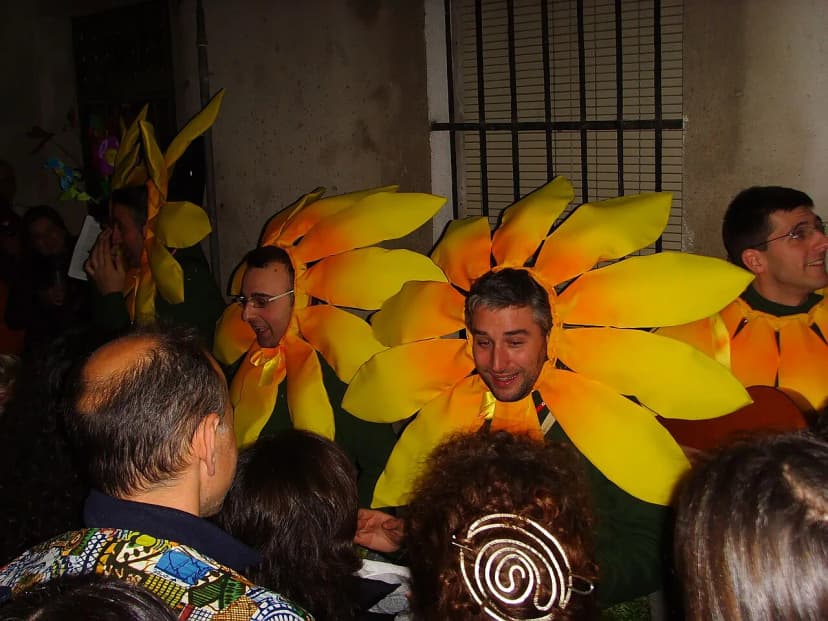
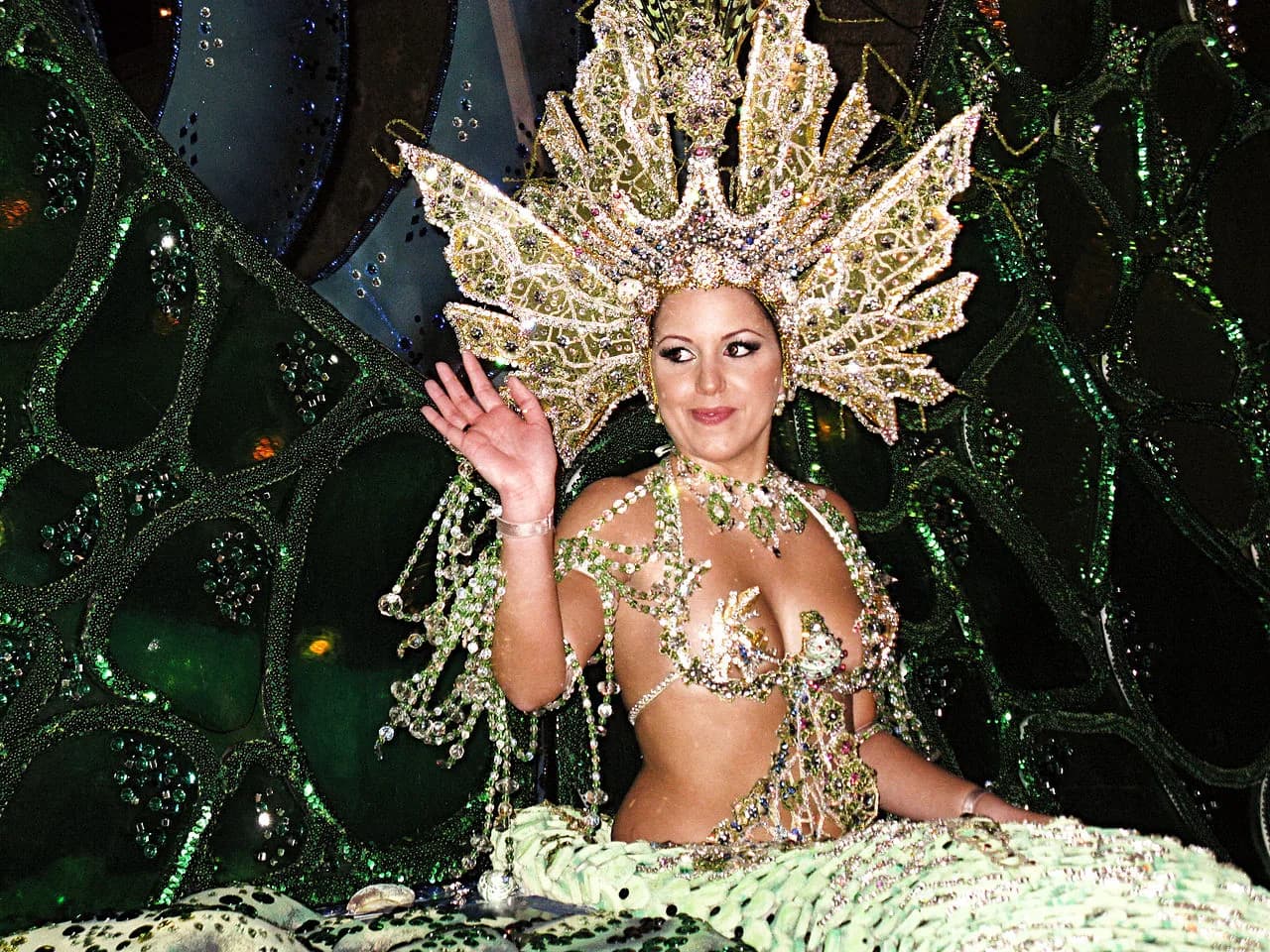
Last updated July 2026, the Carnaval de Santa Cruz de Tenerife remains one of the world's largest carnivals, rivaling Rio de Janeiro for scale. Unlike the satirical, lower-key Carnival of Cádiz, this Canary Islands festival runs on spectacle, with feathered Queen costumes and all-night street dancing. The dates move every year around Lent, so confirm the exact February or March dates before booking flights or hotels.
What Makes the Carnaval de Santa Cruz de Tenerife One of the World's Largest Carnivals
Santa Cruz de Tenerife is the capital of Tenerife, the largest of Spain's Canary Islands. Wikipedia and the festival's own historians rank the Carnaval de Santa Cruz de Tenerife as the second-largest carnival in the world, behind only Rio de Janeiro. Santa Cruz and Rio are officially twinned cities, a link the carnival itself helped create. Queen candidates compete in costumes that can top £220, more than 100 kilograms, typically mounted on wheeled frames so they can be worn on stage. In 1987, Cuban singer Celia Cruz drew a crowd of 250,000 to Plaza de España, a gathering the Guinness Book of Records certified as the largest outdoor concert audience on record. A 2019 concert by Juan Luis Guerra reportedly topped 400,000 attendees, though no notary was present to make that figure official. Spain's Secretary of State for Tourism designated the festival a Fiesta of International Tourist Interest in 1980. Valencia's Las Fallas holds the same distinction. So does Pamplona's Running of the Bulls. The carnival also carries an aspiration toward UNESCO Intangible Cultural Heritage status, though that recognition has not yet been granted. Because the festival is movable, tied to Lent rather than a fixed date, check the current-year schedule on the Spain festival calendar before booking anything.
Posters and Yearly Themes: The Visual Identity of Carnival
Every Carnival has carried an official theme since 1987, when planners built the Plaza de España into a Roman-style colonnade for the theme 'Rome.' Later years reimagined the plaza as Millennial Egypt and other settings, with the theme shaping stage design, costumes, and float decoration citywide. For 2025, the official Carnaval de Tenerife site listed 'Africa' as the theme. Themes change every year, so check the official site for the current one before planning a costume around it. Alongside the theme, Santa Cruz has commissioned an official Carnival poster every year since 1962, with contributions from artists including Javier Mariscal and César Manrique.
Official Carnival vs Street Carnival: Two Different Events
The Carnaval de Santa Cruz de Tenerife actually runs as two separate festivals under one name. Its official half features more than 100 groups. Murgas, comparsas, rondallas, and other musical ensembles compete for prizes at the Recinto Ferial, the city's fairgrounds and conference center. Those contests require tickets, and the results get broadcast on national Spanish television. Its street half is free. Crowds fill Plaza de España and Avenida de Anaga every night from the opening parade through the Burial of the Sardine, with no ticket required. Webtenerife's own visitor guide puts it bluntly: only one person in a thousand, maybe one in ten thousand, shows up without a costume.
The Carnival Calendar: Queen's Gala to the Burial of the Sardine
The Carnaval de Santa Cruz de Tenerife begins about two weeks before Ash Wednesday, roughly 52 days before Easter Sunday. Because Easter shifts every year, so does Carnival, landing anywhere from early February to mid-March. Here is how the core week typically unfolds.
Carnival dates shift between February and March because they depend on Easter—roughly 52 days before Easter Sunday each year—which means hotel booking becomes urgent: rates spike during Carnival week, so reserve early or plan a base outside the city.
- Wednesday (week one): Gala de la Reina crowns the year's Carnival Queen in a costume competition.
- Friday: The Opening Parade sends thousands of costumed marchers through the city center to start the street carnival.
- Saturday through Monday: Murgas, comparsas, and rondallas perform in preliminary and final contests at the Recinto Ferial.
- Tuesday: The Gran Coso, the week's largest parade, fills Avenida de Anaga with floats and every competing group.
- Ash Wednesday: The Entierro de la Sardina parades a giant sardine effigy through the streets, led by mourning 'widows,' before burning it to close the official Carnival.
Piñata Weekend: The Carnival After Ash Wednesday
Carnival does not end at the Burial of the Sardine. About a week later, Piñata Weekend brings back the Daytime Carnival and another round of night parades. Santa Cruz's celebrations close for good on that Sunday. Other municipalities pick up where the capital leaves off. Güímar, Los Gigantes, Candelaria, and Tacoronte each run their own Carnival week after Santa Cruz wraps up.
Getting to Santa Cruz and Getting Around During Carnival
Coming from the south of the island, you will likely start from a resort town like Los Cristianos. TITSA, Tenerife's island-wide bus operator, adds extra Green Line services toward Santa Cruz during Carnival season. Schedules and stops shift year to year, so confirm the current Carnival timetable directly with TITSA before relying on it. Traffic and parking in central Santa Cruz get difficult once the street parties start, especially around Plaza de España and Avenida de Anaga. Arrive on public transport before early evening, ahead of the crowds, to make the walk to the parade route easier. Book the return trip before heading out on Coso night, since taxi and bus queues both lengthen fast once the parade ends near midnight.
Where to Stay: Santa Cruz, La Laguna, or the South
Where you stay comes down to a trade-off between proximity and sleep.
| Location | Proximity to Events | Sleep/Quiet | Cost |
|---|---|---|---|
| Santa Cruz de Tenerife | Walking distance to every parade and party | Street noise runs past sunrise most nights | Hotel rates spike for Carnival week |
| San Cristóbal de La Laguna | Connected to Santa Cruz by tram | Quieter base | |
| The South (Los Cristianos, Playa de las Américas) | Longest commute by bus or car | Nights stay calmer | Rooms often cost less |
- Santa Cruz de Tenerife: walking distance to every parade and party, but street noise runs past sunrise most nights, and hotel rates spike for Carnival week.
- San Cristóbal de La Laguna: connected to Santa Cruz by tram, giving a quieter base with an easy ride into the festival zone.
- The south (Los Cristianos, Playa de las Américas): the longest commute by bus or car, but rooms often cost less and nights stay calmer.
Tickets: What's Free and What Sells Out in Minutes
Every street event in the Carnaval de Santa Cruz de Tenerife is free, requiring nothing but a costume. Tickets only come into play for the seated contests, the Gala de la Reina and the Murgas Adultas Final. Both routinely sell out more than 20,000 seats within 15 to 60 minutes of going on sale, according to figures reported on Wikipedia's Carnival page. Ticket release dates and prices are announced through the official Carnaval de Tenerife website and its social media accounts. Following those channels in the weeks before Carnival is the only reliable way to catch a release window. Compared to the free street events, the ticketed galas are the exception, so most of a Carnival trip costs nothing beyond flights, a room, and a costume.
- Free: Opening Parade, nightly street dancing, the Gran Coso, and the Burial of the Sardine.
- Ticketed: Gala de la Reina and the Murgas Adultas Final, both prone to selling out within the hour.
Carnaval de Día: The Family-Friendly Option
Carnaval de Día runs in daylight on several days, including Piñata Weekend, with music and dancing starting well before dark. It draws a calmer crowd than the overnight street parties, making it the option local tourism guides point families toward first. Costumes are still expected, and crowds still fill Plaza de España, but the atmosphere stays lighter than Coso night or the Sardine's funeral procession. If unsure about the all-night scene, treat Carnaval de Día as a lower-commitment way to see the costumes and music up close.
La Casa del Carnaval: Carnival Year-Round
La Casa del Carnaval gives Carnival a year-round home in Santa Cruz de Tenerife. The museum sits in Barranco de Santos, at Aguere Street 17 (postal code 38005), next to the Puente Galcerán bridge. Its permanent exhibition displays the reigning Carnival Queen's costume alongside past winners, plus historic posters dating back to the 1960s. A separate hall, Sala Suspi, hosts temporary exhibitions and talks. An audio guide, available in English and Spanish, comes included with the visit. Admission runs on free tickets, reserved in advance through the museum's own site. As of its published hours, the museum opens daily from 9 a.m. to 7 p.m. Call +34 922 04 60 20 to confirm the current schedule before visiting.
What to Wear: The Costume Rule Nearly Everyone Follows
Skipping a costume at the Carnaval de Santa Cruz de Tenerife is the fastest way to feel out of place. Local costume shops around the city center stock last-minute options at affordable prices, from wigs and face paint to full outfits, and many stay open late during Carnival week. There is no dress code beyond showing up dressed: elaborate, homemade, thrifted, and simple face paint all count. Carnival characters on the street range from hairy-legged cheerleaders to costumes built around a fantasy film, and both extremes are normal here.
Murgas, Comparsas, and Rondallas: Understanding the Contests
Murgas are the heart of the official Carnaval de Santa Cruz de Tenerife's contests. A murga is a musical theater troupe of roughly 20 to 100 members who perform original songs mocking the year's political and social news. The first modern murga is credited to Los Bigotudos in 1954, a group that survives today as Afilarmónica NIFU-NiFá. Comparsas bring conga-driven dance music and choreography rather than satire, while rondallas perform with acoustic string instruments. Because the humor depends on Spanish wordplay and current events, visitors without fluent Spanish will follow the spectacle more easily than the lyrics. That is also the contrast with Cádiz's Carnival, where satire carries the show and Santa Cruz leans harder into visual spectacle.
Murgas—the musical theater troupes now central to the official contests—trace their roots to Franco-era resistance. Los Bigotudos, founded in 1954 and later renamed NIFU-NiFá, pioneered the modern murga tradition, using humor and wordplay for social commentary when direct Carnival celebrations were restricted.
Common Mistakes to Avoid in Santa Cruz
A few mistakes catch first-time visitors again and again at the Carnaval de Santa Cruz de Tenerife.
- Assuming the dates repeat from last year: Carnival moves with Lent, so the schedule shifts every year.
- Waiting until arrival to book Gala de la Reina or Murgas Adultas Final tickets, which can sell out in under an hour.
- Booking a hotel inside Santa Cruz without expecting street noise well past midnight during the main week.
- Driving into the city center on Coso Tuesday, when street closures and crowds make parking impractical.
- Skipping a costume at street parties and standing out among a crowd that is almost entirely dressed up.
How Carnival Survived the Franco-Era Ban
Santa Cruz kept its Carnival alive even when public Carnival celebrations were restricted under Francisco Franco’s dictatorship. Organizers used the approved name Fiestas de Invierno, or Winter Festivals, while preserving costumes, music, and community performances.
The workaround helped local traditions continue between the 1940s and 1970s. Murgas became especially important during this period because their humorous songs offered space for indirect social commentary. Los Bigotudos, founded in 1954 and later renamed NIFU-NiFá, helped establish the modern murga tradition.
The festival recovered the Carnival name after Spain’s transition to democracy. Its national profile then grew quickly, followed by recognition as a Fiesta of International Tourist Interest in 1980. This history explains why Carnival carries meaning beyond spectacle in Santa Cruz. Costumes and satire also represent the survival of local identity through decades of official restrictions.
For trip-planning details, see Carnaval de Tenerife official and Visit Tenerife (official tourism).
Explore carnival in other cities
Frequently Asked Questions
Is the Carnaval de Santa Cruz de Tenerife free to attend?
Street events are free, including the Opening Parade, nightly dancing, the Gran Coso, and the Burial of the Sardine. Only the seated contests, the Gala de la Reina and the Murgas Adultas Final, require tickets, and those sell out within 15 to 60 minutes of release.
What is the best day to attend the Santa Cruz Carnival?
Tuesday brings the Gran Coso, the largest single parade of the week, along Avenida de Anaga. Friday's Opening Parade is a strong alternative for a first taste of the street carnival without quite as dense a crowd.
Can families visit the Carnival with children?
Carnaval de Día runs in daylight on several days, including Piñata Weekend, with a calmer crowd than the overnight street parties. It is the option local tourism guides recommend first for a family visit.
How do you get from Los Cristianos to the Santa Cruz Carnival?
TITSA, the island's bus operator, adds extra Green Line services toward Santa Cruz during Carnival season. Confirm the current Carnival-week timetable directly with TITSA before traveling, since schedules shift from year to year.
When is the Carnaval de Santa Cruz de Tenerife held?
The festival begins about two weeks before Ash Wednesday, roughly 52 days before Easter Sunday, so exact dates move between February and March each year. Check the current-year schedule before booking flights or hotels.
Is the Carnaval de Santa Cruz de Tenerife safe to attend?
The official Carnaval de Tenerife FAQ describes the event as safe and well organized, with police reinforcement, medical posts, and information points throughout the city. Street parties get crowded fast, so keep valuables secure and agree on a meeting point with your group in advance.
What does Coso mean in Tenerife's Carnival?
Coso refers to Tuesday's Gran Coso, the week's largest single parade, when every competing group and float fills Avenida de Anaga. It marks the grand finale of the official contest week.
What happens during the Burial of the Sardine?
A giant sardine effigy is paraded through Santa Cruz on Ash Wednesday, mourned by costumed 'widows' along the route, then set on fire to close the official Carnival. A last street party follows the fire.
What is the Gala de la Reina?
The Gala de la Reina is the Wednesday competition that crowns the year's Carnival Queen in elaborate, wheeled costumes. RTVE and other Spanish networks broadcast it nationally each year.