Last updated July 2026, this guide breaks down Semana Santa Malaga's processions, 2026 dates, and where to stand for the best view. Holy Week shifts every year with the liturgical calendar; in 2026 it ran from Palm Sunday, March 29, to Easter Sunday, April 5. Expect brass bands, dense crowds along Calle Larios, and the Spanish Legion's morning arrival at Muelle Uno on Holy Thursday.
What Makes Semana Santa in Malaga Different
Málaga calls its processional floats tronos rather than the pasos used elsewhere in Andalusia, and carries them on long shoulder-borne beams called varales. Forty-two brotherhoods stage 45 separate processions across the week, a scale that gives Semana Santa Malaga a different rhythm than smaller regional Holy Weeks. Between 6 and 10 processions move through the city on a typical day, each departing from and returning to its brotherhood's home church. Processions usually start around 3:00 pm and some run until 5:00 or 6:00 am the next morning, so pace yourself across the week rather than trying to catch everything on day one. Spanish Legion troops march with the Mena brotherhood on Holy Thursday, adding a military cadence that's one of the week's signature scenes. Some Holy Week traditions in northern Spain stay hushed and interior. Málaga's version plays out loud and communal, with brass bands and flamenco-style saetas sung from balconies as thrones pass below. Incense drifts through the crowd alongside the scent of orange blossom, since Holy Week falls during Málaga's spring bloom. If the solemnity isn't the draw, the city's other signature event, the Feria de Málaga, delivers a different mood five months later.
Semana Santa Malaga 2026 Dates at a Glance
Holy Week is movable, tied to the date of Easter rather than a fixed spot on the calendar, so it lands on different dates every year. In 2026, Málaga's Semana Santa ran from Palm Sunday, March 29, through Easter Sunday, April 5. Use the table below as a reference for that week. Confirm the exact dates for whichever year you're traveling with the Agrupación de Cofradías, the federation that publishes the official annual schedule. Travelers stretching a longer Andalusia trip around Holy Week sometimes add Córdoba's patio festival, held in the weeks that follow Easter, as a rail day trip from Málaga.
| Day | 2026 Date | Highlight |
|---|---|---|
| Palm Sunday | March 29 | La Pollinica opens the week |
| Holy Monday | March 30 | El Cautivo processes |
| Holy Tuesday | March 31 | Processions continue across brotherhoods |
| Holy Wednesday | April 1 | El Rico prisoner-pardon tradition |
| Holy Thursday | April 2 (public holiday) | Spanish Legion arrival and the Mena procession |
| Good Friday | April 3 (public holiday) | Servitas midnight procession, streetlights off |
| Holy Saturday | April 4 | No processions; Corrida Picassiana bullfight |
| Easter Sunday | April 5 | Resurrection procession closes the week |
7 Must-See Moments of Semana Santa in Malaga
These seven moments give the week its shape, from the family-friendly opener on Palm Sunday to the Resurrection procession on Easter Sunday.
The Spanish Legion arrives on April 2, the public holiday marked by fullest streets and heaviest transport disruption; restaurant reservations near the route book out months in advance specifically for this peak day.
- Palm Sunday: La Pollinica (March 29)
- The Hermandad de la Pollinica opens Holy Week on Palm Sunday, with children waving palm branches along the route.
- Local tradition calls for wearing new clothes to this first, family-oriented procession of the week.
- The Lágrimas y Favores brotherhood also departs on Palm Sunday, and its membership has long included Málaga-born actor Antonio Banderas.
- Holy Monday: El Cautivo (March 30)
- Known locally as The Lord of Málaga, El Cautivo is the Hermandad del Cautivo's procession and one of the most attended images of the week.
- Thousands of Malagueños walk alongside the throne for its entire route.
- Early positioning helps if you want to see it depart from the brotherhood's home church rather than catch it mid-route.
- Holy Wednesday: El Rico's Prisoner Pardon (April 1)
- Each year one brotherhood nominates a prisoner of good conduct for pardon and release, a custom tied to the Hermandad del Rico.
- The tradition traces back to 1759, when prisoners asked to help carry a throne and the request grew into today's annual pardon.
- Holy Thursday: Mena and the Spanish Legion (April 2)
- Spanish Legion troops land by boat at Muelle Uno in the port on Holy Thursday morning, drawing crowds before marching into the center.
- The Legionnaires escort the Cristo de la Buena Muerte throne, known as Mena, while singing their anthem, El Novio de la Muerte.
- Holy Thursday is a public holiday in Málaga, so expect the fullest streets and heaviest transport disruption of the week.
- Good Friday: Servitas (April 3)
- The Orden de los Servitas processes near midnight in one of the week's most subdued moments.
- Streetlights along the route switch off as the brotherhood mourns the death of Christ, leaving candlelight as the main source of light.
- Good Friday is also a public holiday, so plan transport and dining around closed businesses.
- Holy Saturday: The Corrida Picassiana (April 4)
- There are no processions on Holy Saturday, since Málaga's brotherhoods pause while awaiting the Resurrection.
- Instead, the Plaza de Toros de La Malagueta hosts the Corrida Picassiana, a bullfight decorated with scenography inspired by Málaga-born artist Pablo Picasso.
- Tickets for this single annual event are hard to secure, so check availability well before Holy Week if it interests you.
- Easter Sunday: The Resurrection (April 5)
- Representatives from all of Málaga's brotherhoods join a joint procession celebrating the Resurrection, closing the week on its most colorful note.
- It runs shorter and brighter than the earlier processions, a reasonable pick if you want one less-crowded event to watch.
How the Processions Work: Tronos, Nazarenos, and Music
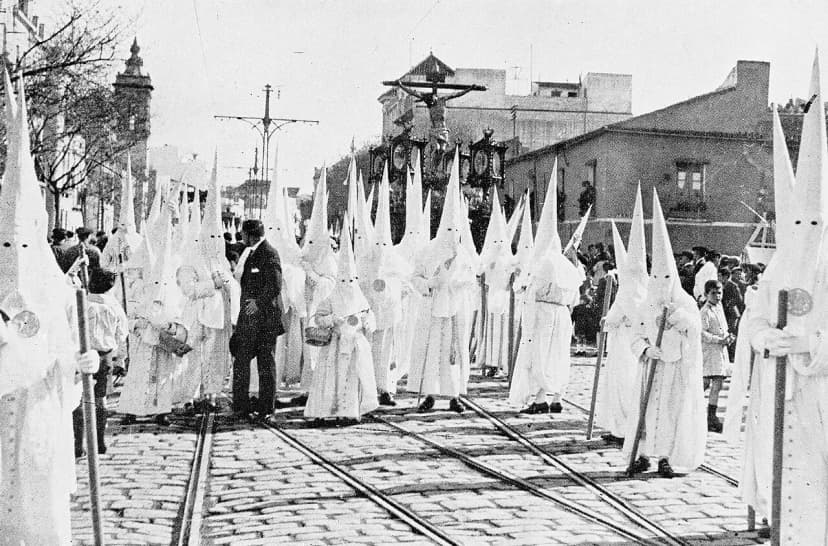
Each procession follows a set order behind a cross guide, or Cruz de Guía, that leads the way. Nazarenos walk in tunics and a pointed hood called a capirote, a penitential garment whose color changes by brotherhood and whose point conceals the wearer's identity rather than signaling anything else to first-time visitors. Brass bands set the processional rhythm, and saeta singers sometimes break into flamenco-style verses from balconies as a throne passes below. Costumed, symbol-heavy pageantry like this has parallels elsewhere in Spain. The Moros y Cristianos festival in Alcoy stages its own elaborate costumed battles each year. Near Elche, the Misteri d'Elx performs a centuries-old sacred drama with similarly deep local roots.
- Throne weight
- Málaga's tronos can weigh between 3,200 kg and 4,200 kg fully dressed, according to figures published by Solaga's Holy Week guide.
- Bearers per throne
- Some thrones need up to 280 costaleros, or bearers, working in relays to complete the route.
- Varales (support beams)
- Each throne rests on 6 to 8 long beams called varales, typically 8 to 14 meters long, carried directly on the bearers' shoulders.
- Route length
- A full procession can cover roughly 6,360 meters and last around 8 hours from departure to return.
Where to Watch: Official Route and Seating Options
The Recorrido Oficial, or official route, runs through the center and passes along Calle Larios before reaching Málaga Cathedral. Where you stand changes both the price and the atmosphere, so weigh the options below before Holy Week fills up. Paid boxes book out months ahead, while free standing space rewards showing up early.
| Option | Cost | Notes |
|---|---|---|
| Tribuna Central (paid boxes) | Up to €600 | Book months ahead directly through the Agrupación de Cofradías |
| Resale chairs | From €70 | Individually resold seats appear online closer to Holy Week |
| Tribuna de los Pobres | Free | Standing area that has traditionally started at Calle Carretería; recent street work means it's worth confirming current access with the tourist office |
| Balcony rental | Priced per booking | Private balconies overlooking the route, rented directly from residents or agencies |
Standing vs Sitting: Weighing the Trade-offs
Both options work, but they suit different travelers. Wheelchair and stroller access is limited during peak procession hours, since barricades and crowds block many side streets. Paid seating areas are generally easier to navigate than standing zones, since they offer a fixed, accessible spot rather than a shifting crowd.
| Option | Pros | Cons |
|---|---|---|
| Standing (e.g. Tribuna de los Pobres) | Free, closer to the crowd's energy, no advance booking needed | Hours on your feet, tighter crowding, harder for kids or older travelers |
| Paid seating (e.g. Tribuna Central) | Guaranteed sightline, a seat instead of hours standing, easier with mobility needs | Higher cost, needs booking months ahead, popular processions sell out |
Survival Tips for Holy Week in Malaga
Candle wax drips onto the cobblestones throughout the week and turns slick within a few passes, so wear flat, closed shoes with grip. Restaurants near the official route fill up fast, so reserve tables well before Holy Thursday and Good Friday, the week's two public holidays.
Processions span roughly 6,360 meters and last around 8 hours, moving thrones weighing 3,200 kg and 4,200 kg through crowded streets; standing observers should wear flat, grippy shoes because candle wax makes cobblestones slick after multiple passes.
- Escape to the coast
- Pedregalejo and El Palo sit a few kilometers east of the center and stay noticeably calmer, with chiringuitos serving seafood away from the crowds.
- Skip driving
- The historic center closes to cars during processions and parking disappears, so plan to walk or use public transport instead.
- Check transport schedules
- Bus and metro routes adjust around road closures during Holy Week, so confirm current schedules with the local transport authority before heading out at night.
- Book restaurants early
- Tables near the official route go fast during Holy Week, especially around Holy Thursday and Good Friday.
- Plan around Spain's other festival dates
- Madrid's San Isidro is one option later in the year.
- Alicante's Hogueras de San Juan is another.
- So is Haro's Batalla del Vino.
- Barcelona's Festa Major de Gràcia rounds out the list.
History: From the Reconquista to the Agrupación de Cofradías
Holy Week's roots in Málaga reach back to the Catholic Monarchs, Ferdinand II of Aragon and Isabella I of Castile, who completed the Reconquista with the fall of Granada in 1492. Religious imagery became a teaching tool for a largely illiterate population in the centuries that followed, and the processional tradition grew from that practice. Spain's tourism authority named Holy Week in Málaga a Fiesta of International Tourist Interest in 1965, a designation that reflects its scale today. Much of the original sculpture collection did not survive the church burnings of 1931. Sculptors including Mariano Benlliure, Francisco Palma Burgos, and Antonio Castillo Lastrucci carved replacements after the Civil War, and many of those pieces are the ones now carried through the streets. The Agrupación de Cofradías, the federation of brotherhoods, coordinates each year's routes and timings and publishes the official itineraries and safety guidance that processions follow. Andalusia's religious calendar doesn't stop at Easter Sunday; a few weeks later, the Romería del Rocío pilgrimage draws its own crowds.
Where to Watch Beyond the Official Route
The official route offers predictable sightlines, but the approach and return legs often feel more intimate. Check each brotherhood’s published itinerary before choosing a neighborhood, since streets and timings can change annually.
Barrio de la Victoria is a strong alternative to Calle Larios. Processions squeeze through narrower streets near Plaza de la Merced and the Basílica de la Victoria, bringing the tronos closer to spectators. La Trinidad offers another neighborhood setting, especially during El Cautivo’s long Holy Monday journey.
- Arrive before the Cruz de Guía reaches your chosen street, because police may close pedestrian crossings.
- Stand near a wider junction if you need an easier exit after the throne passes.
- Avoid blocking doorways, wheelchair routes, or the space required for bearers to maneuver.
Return legs can occur after midnight and usually have fewer casual spectators. They also demand more patience because accumulated delays affect published times. Keep a second route out of the area, as temporary barriers can prevent crossing behind a procession.
For trip-planning details, see Semana Santa in Malaga official source and Malaga / regional tourism authority.
Frequently Asked Questions
When does Semana Santa happen in Malaga in 2026?
Palm Sunday fell on March 29, 2026, and the week closed with Easter Sunday on April 5, 2026. Holy Week shifts every year with the Christian liturgical calendar, so those exact dates won't repeat. Check the Agrupación de Cofradías' published schedule for whichever year you're planning around.
How much does it cost to watch the processions?
Paid seats at the Tribuna Central along the official route have run as high as €600 when booked directly, and individually resold chairs start around €70. Standing for free at the Tribuna de los Pobres costs nothing, but it means hours on your feet and a rowdier crowd.
What's the difference between Malaga's tronos and pasos used elsewhere in Andalusia?
Málaga uses the term tronos for its processional floats rather than pasos, and carries them on long shoulder-borne beams called varales. Some can weigh between 3,200 kg and 4,200 kg and need up to 280 bearers to move through the city.
Where can you go to escape the Holy Week crowds?
Head east to Pedregalejo or El Palo, a few kilometers from the center, where the atmosphere stays noticeably calmer and chiringuitos keep serving seafood through the week. Both neighborhoods sit outside the official procession route, so processions rarely reach them.
Do wheelchairs and strollers work well during Holy Week?
Not easily. Barricades line the official route during processions, and blocked side streets make detours common, so budget extra time for any crossing. Paid seating areas tend to be easier to navigate than standing zones, since they offer a fixed spot rather than a shifting crowd.
Do you need to book restaurants during Holy Week?
Yes. Tables near the official route fill up quickly, especially for Holy Thursday and Good Friday, Málaga's two public holidays that week. Reserve ahead if you want to eat close to the procession route rather than grabbing something on the go.
More Spanish Fiestas
The traditional fiestas worth building a trip around, with the date rule and the logistics trap for each.
Spring
- Moros y Cristianos Alcoy
- Patios de Córdoba Festival 2026
- Fiestas de San Isidro Madrid
- Romería del Rocío 2027