Last updated July 2026. La Mercè Barcelona is the city's biggest annual festa major, and the 2026 edition runs September 23 to 27 with the public holiday falling on September 24. Nearly everything on the program is free, so the real planning challenge is choosing among roughly 500 activities packed into one week across squares, parks, and a beachfront. This guide sorts essential fire runs, human towers, and concerts from optional extras, and covers the transit and safety details that shape how the week plays out.
What Is La Mercè Barcelona? The Fast Answer
La Mercè is Barcelona's festa major, the city's official annual festival held each September in honor of Our Lady of Mercy. Saint Eulàlia shares co-patron status with Our Lady of Mercy over Barcelona, a dual patronage that shows up across the festival's imagery. The tradition dates to a 1687 locust plague, when the city's governing council asked the Virgin for help and later named her patroness. Barcelona has marked the occasion as an official city holiday since 1871.
| Detail | 2026 Specifics |
|---|---|
| Dates | September 23-27, 2026 |
| Public holiday | September 24 (La Diada de la Mercè) |
| Cost | Free for the vast majority of concerts, parades, and street events |
| Guest city | Shanghai, marking 25 years as Barcelona's sister city |
| Optional paid extra | Cursa de la Mercè 10-kilometer race (about 6.2 miles), €5 registration, held on a separate weekend from the main festival |
| Vibe | Catalan tradition alongside contemporary street art and music |
2026 Dates, the Diada Holiday, and What Stays Open
September 24 is Barcelona's official public holiday, La Diada de la Mercè, and it falls in the middle of the 2026 festival dates of September 23 to 27. Banks, public offices, and many neighborhood shops close for the day. Restaurants, museums, and tourist-facing businesses in the Gothic Quarter and Eixample generally keep longer hours during the festival, though it is worth checking individual listings. TMB's metro network runs all night on the festival's peak nights, so getting home after a late Piromusical or correfoc does not require timing the last train.
- Banks, post offices, and government buildings: closed on September 24
- Neighborhood shops in residential districts: mostly closed for the holiday
- Restaurants and museums in central tourist areas: normal or extended hours in past editions
- Metro (all lines): overnight service on the festival's busiest nights
The Big Four Catalan Traditions
Castellers, correfoc, gegants, and sardana are the four traditions that define the week for most first-time visitors. Each has its own rhythm and its own comfort level for children. The correfoc deserves particular preparation. Cotton or another natural fiber is the safest clothing choice, since synthetic fabric can melt near falling sparks. Closed-toe shoes are essential, and a hat or hood protects hair and scalp. Glasses or sunglasses shield your eyes from sparks, and ear protection helps if loud drumming bothers you. Many editions also run a shorter, lower-intensity children's correfoc earlier in the evening, separate from the main adult run, so check the official program for that year's exact timing. Fire traditions in Spain do not stop with the correfoc. Valencia's Las Fallas fire festival burns entire monuments each March, a bigger and more destructive spectacle than Barcelona's street run.
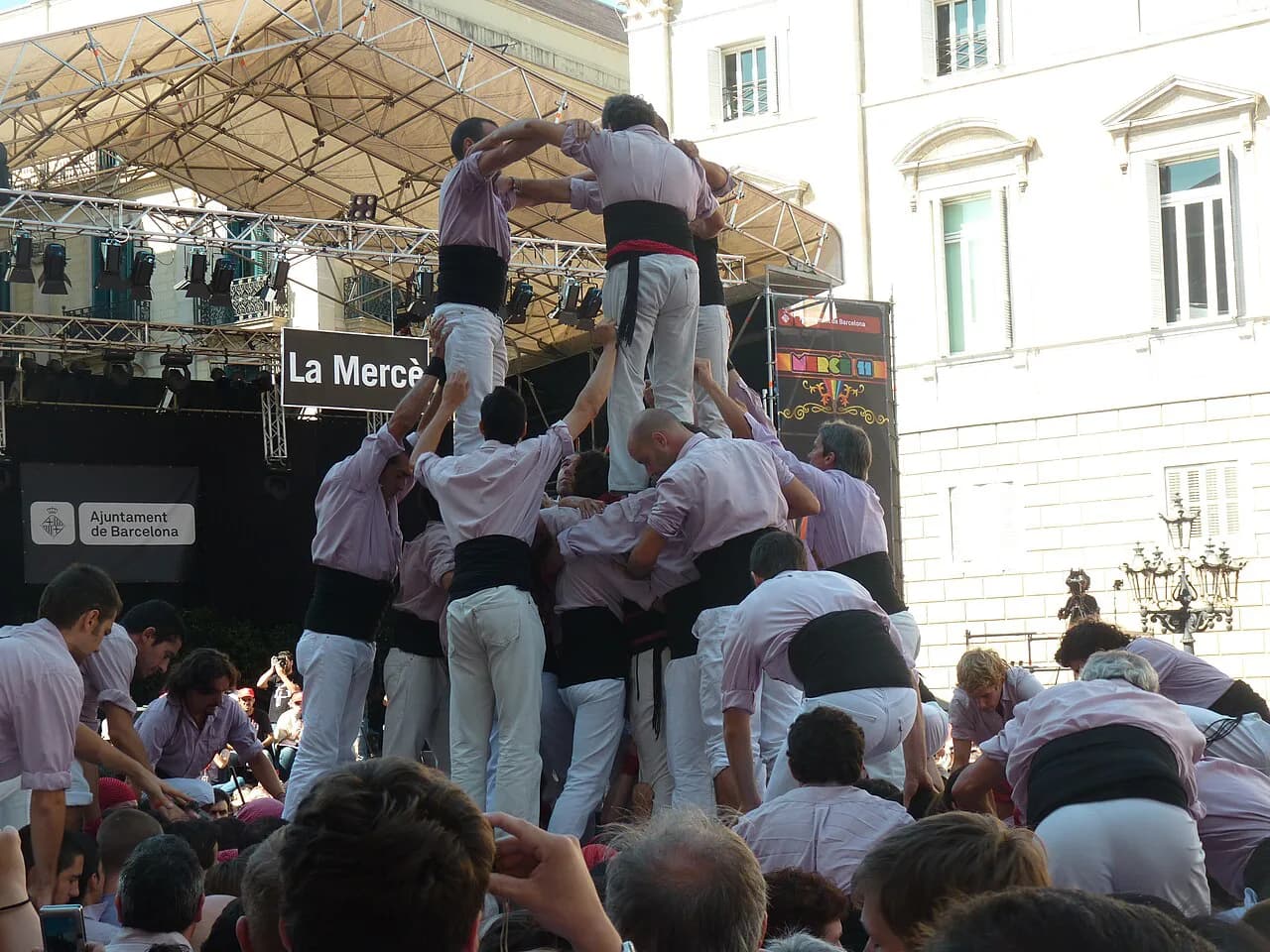
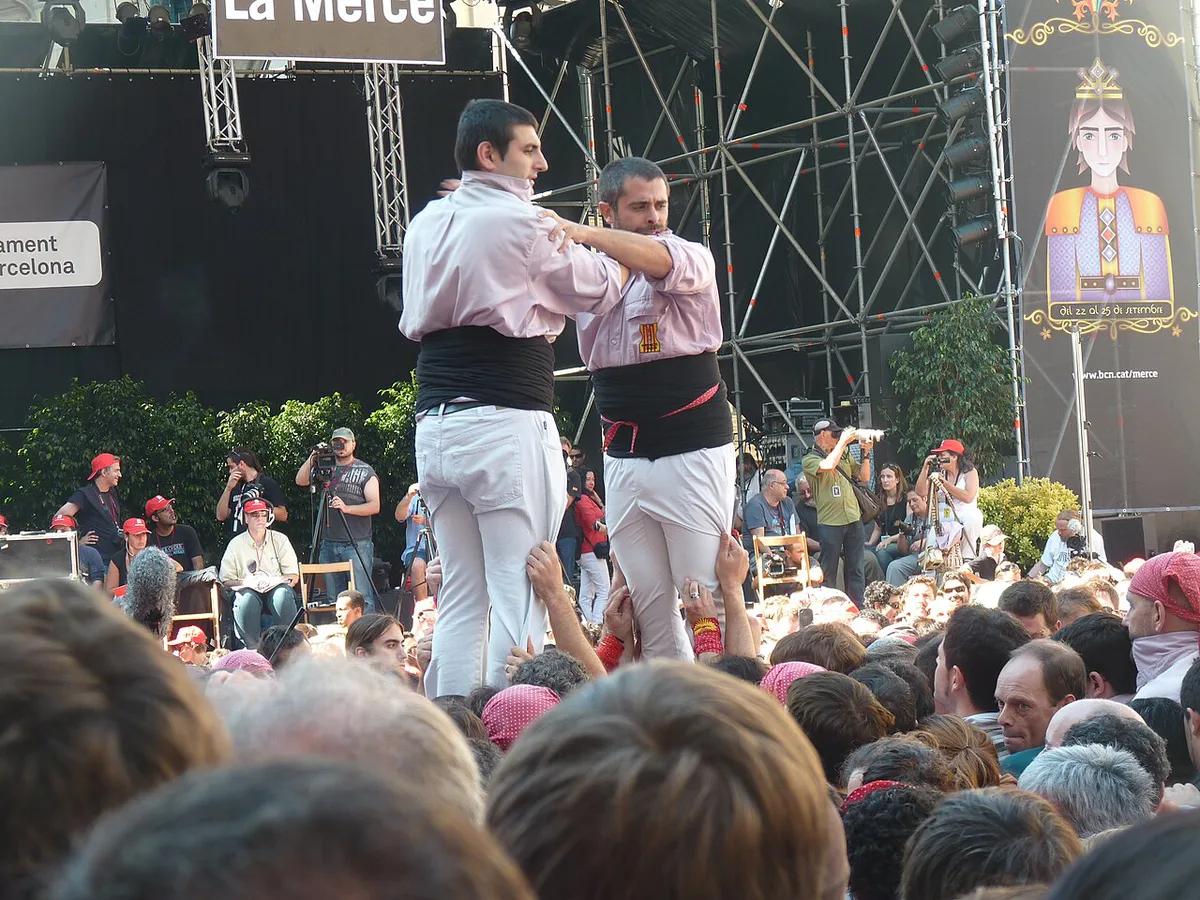
- Castellers: colles build multi-tiered human towers in Plaça de Sant Jaume, finished when a child called the enxaneta climbs to the top and raises a hand
- Correfoc: devils, fire-beasts, and falcons run through the streets under falling sparks while drums keep pace
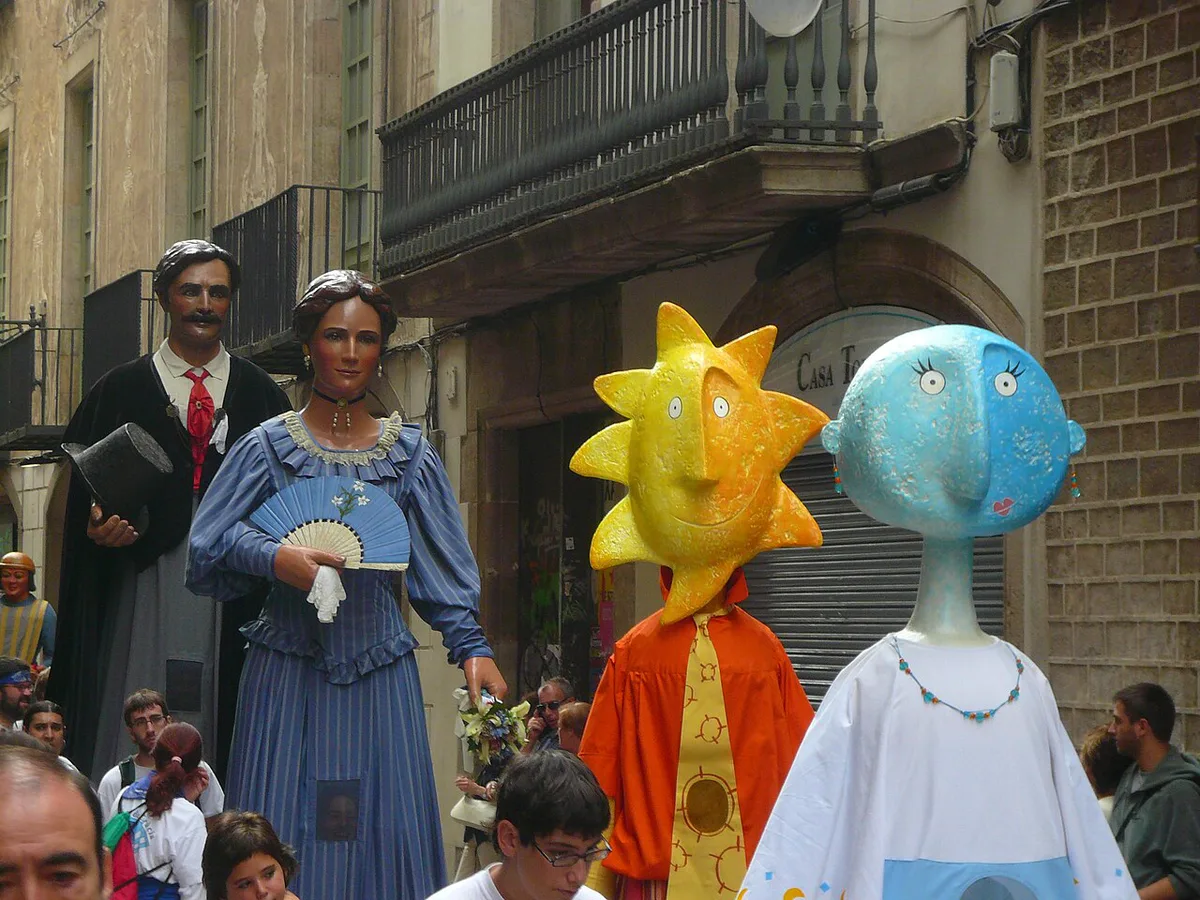
- Gegants i capgrossos: papier-mâché giants and oversized-head figures parade through central streets, a format introduced in 1902
- Sardana: a circle dance from Empordà, also popularized in 1902, that any visitor can join rather than just watch
2026 Highlights: Falgueras' Opening Speech, Cinta Vidal's Poster, and Shanghai as Guest City
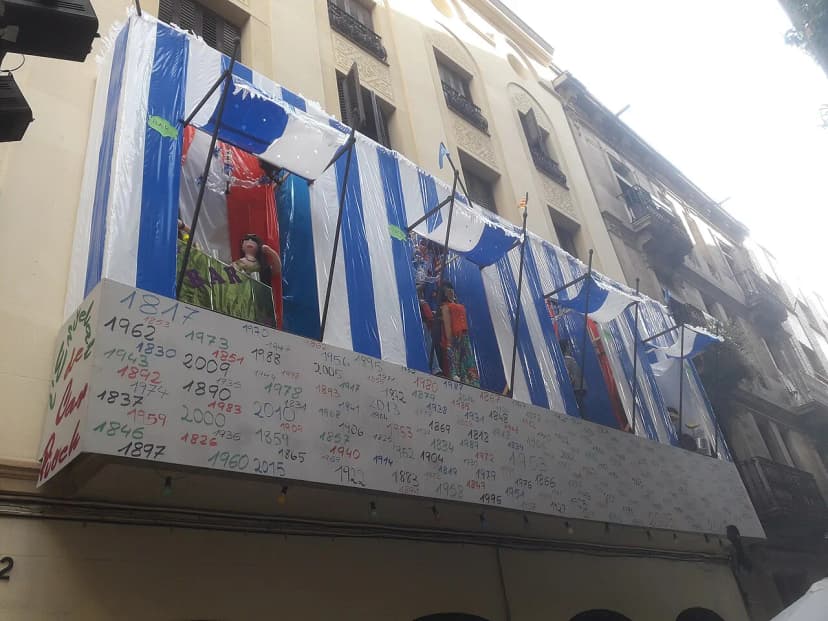
Three details set the 2026 edition apart from a generic La Mercè write-up. Antoni Falgueras, the master cellarer behind Celler de Gelida on Carrer de Vallespir, delivers this year's opening speech. His family has run the shop since 1895, four generations selling wine, oil, and soap from the same storefront in Sants. This year's poster, designed by Barcelona-born painter and naturalist Cinta Vidal, folds the city's eleven districts into one multi-perspective composition anchored by the Cathedral, Plaça del Rei, and the Basilica of La Mercè. Shanghai is 2026's guest city, an honor the festival hands to a different partner each year, previously held by Vienna in 2013. The choice marks 25 years since Barcelona and Shanghai became sister cities. More than 100 artists, from Shanghai and from Barcelona's resident Chinese community, bring street arts, music, and cultural programming into the week. Organizers describe Shanghai as the first city from the Asian continent invited to hold the guest-city role, folding Chinese creativity into Barcelona's own street-art traditions rather than staging a separate sideshow.
Key Venues at a Glance
The festival spreads across the whole city, but four venues carry most of the marquee programming. Plaça de Sant Jaume, a central square, hosts the opening speech, the castellers, and sardana dancing. Ciutadella Park anchors MAC's street arts and circus lineup, with performances aimed squarely at families. Montjuïc's Magic Fountain stages the Piromusical finale, reached along Avinguda de la Reina Maria Cristina. Barceloneta's Somorrostro beach hosts a smaller fireworks display on September 25 and 26, ahead of the main event.
The opening speech at Plaça de Sant Jaume features Antoni Falgueras, whose family has operated the Celler de Gelida wine shop continuously since 1895, rooting the festival's ceremonial beginning in four generations of Sants neighborhood heritage.
| Venue | Main Event | What to Expect |
|---|---|---|
| Plaça de Sant Jaume | Opening speech, castellers, sardana | Central stage for the festival's traditional culture |
| Ciutadella Park | MAC street arts and circus performances | Festival's family-programming hub |
| Montjuïc (Magic Fountain) | Piromusical finale | Reached via Avinguda de la Reina Maria Cristina |
| Barceloneta / Somorrostro beach | Preview fireworks, September 25-26 | Smaller waterfront fireworks display |
Music and Arts: BAM, Música Mercè, and MAC
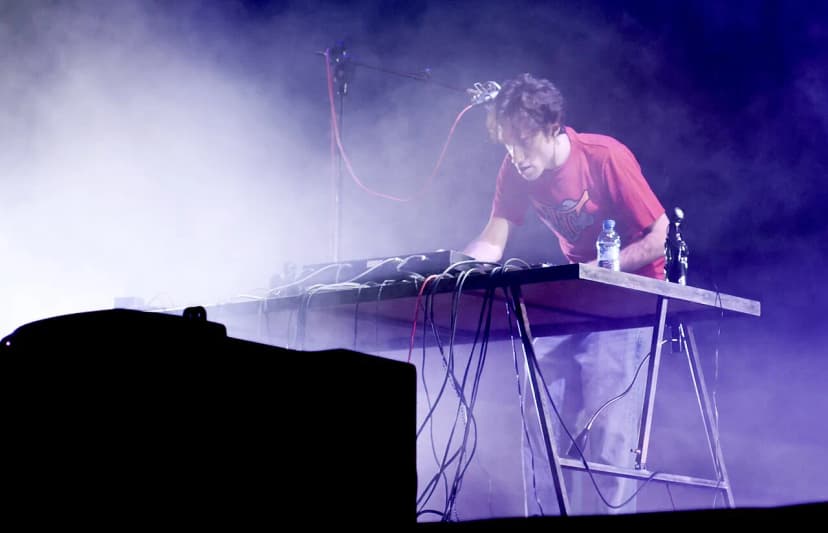
Barcelona's Festa Major doubles as several festivals inside one week, with free concerts split across two parallel programs. BAM leans indie, electronic, and alternative, while Música Mercè covers classical, traditional, and world music on the same five days. Ciutadella Park anchors MAC, the street-arts and circus program, with additional circus staged at Montjuïc Castle from 11 a.m. to 8 p.m.
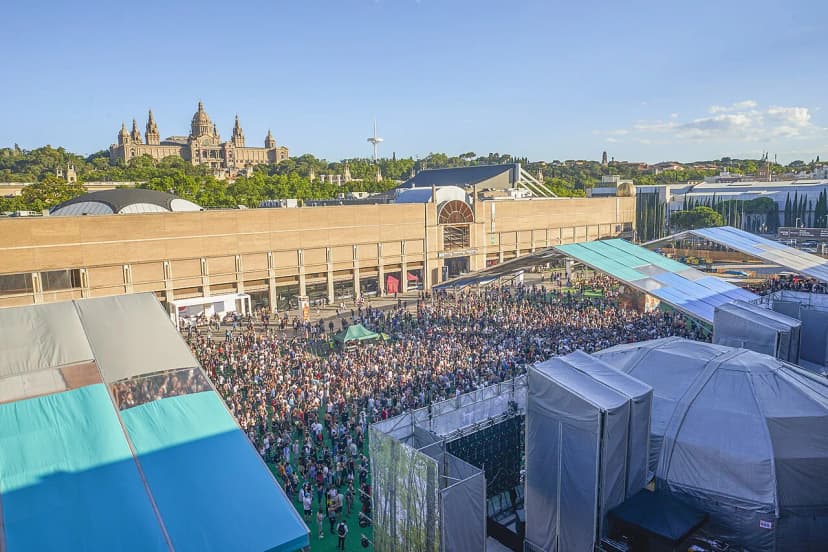
- BAM (Barcelona Acció Musical): free indie, electronic, and alternative acts at Plaça Reial, Plaça de Catalunya, and Antiga Fàbrica Damm, September 23-27
- Música Mercè: free classical, traditional, and world-music concerts running the same five days
- MAC (Mercè Arts de Carrer): circus, street theater, and family performances centered on Ciutadella Park, with extra circus programming at Montjuïc Castle
The Piromusical Finale at Montjuïc
The festival's marquee event is the Piromusical, a synchronized fireworks, water, and music display staged at the Magic Fountain of Montjuïc. In 2026 it runs on September 27 at 22:00. Crowds gather along Avinguda de la Reina Maria Cristina, the boulevard leading up to the fountains. Arriving with less than an hour to spare usually means watching over other people's heads. A quieter preview happens earlier in the week: fireworks light Somorrostro beach in La Barceloneta on September 25 and 26, also at 22:00, with a fraction of the Montjuïc crowd. For the main event, a rooftop bar or a vantage point toward Tibidabo trades a close-up view for open sightlines and an easier walk home.
The Piromusical finale at 22:00 on September 27 coincides with the metro's all-night service on peak festival evenings, eliminating the need to time the last train home after the main spectacle.
Decision Matrix: Tradition vs. Party
Not every La Mercè event asks the same thing of visitors. This table lines up intensity and crowd size so you can pick the nights that match your tolerance for noise, fire, and standing room.
| Event | Intensity | Crowd Size | Best For |
|---|---|---|---|
| Correfoc (fire run) | High: fire, noise, tight streets | High | Adults and older kids prepared with cotton clothing |
| Piromusical at Montjuïc | High: fireworks and dense crowds | Very high | Visitors who arrive early or watch from a distance |
| Castellers in Plaça de Sant Jaume | Moderate: tense but stationary | High | Anyone wanting a close look at the towers |
| BAM / Música Mercè concerts | Low to moderate: open-air and social | Moderate to high, depending on act | Music fans with a genre preference |
| MAC at Ciutadella Park | Low: daytime street performance | Moderate | Families with young children |
| Sardana dancing | Low: participatory, unhurried | Low to moderate | Visitors who want to join in rather than watch |
Local Survival Guide: Mistakes to Avoid
A few recurring mistakes catch first-time visitors off guard. Free does not always mean walk-in. Some indoor shows, workshops, and the open-doors museum visits on September 24 require a pre-booked QR code, even though there is no charge. Pickpocketing risk rises with crowd density, especially around Plaça de Catalunya and in the Gothic Quarter's narrow lanes, so keep bags zipped and phones in a front pocket. Restaurants fill up weeks ahead during the festival, so reserve a table for the nights that matter rather than walking in. Metro lines L1 and L3 carry the heaviest festival traffic and back up fastest around rush hour and event start times. Walking between Ciutadella Park and Plaça de Catalunya is often faster than waiting out a packed train.
- Pedralbes Monastery, the Olympic and Sports Museum, and CosmoCaixa open free on September 24 with no reservation, per the festival's open-doors program
- Sagrada Família, MNAC, and Poble Espanyol also join the open-doors day but require advance reservation, even though entry itself is free
- MACBA, the Picasso Museum, and the Frederic Marès Museum round out the free open-doors list for September 24
Extend the Trip: Where La Mercè Fits in Spain's Festival Year
La Mercè is one stop on a busy Spanish festival calendar, and September's timing makes it easy to pair with other trips across the year.
- Zaragoza's Fiestas del Pilar Zaragoza: A 2026 Travel Guide follows in October, with its own giants and processions honoring a different patron saint
- Seville's Semana Santa processions fill the spring calendar with Holy Week pageantry
- The same city's Feria de Abril follows a few weeks later with a more celebratory tone
- Pamplona's San Fermín festival runs in July, months before La Mercè
- Buñol's La Tomatina 2026: The Complete Survival and Logistics Guide tomato fight follows in late August
- Carnival season brings Cádiz Carnival to the south each February
- The Carnaval de Santa Cruz de Tenerife: 2026 Dates, Tickets, and Tips runs the same week in the Canary Islands
- For the full year-round picture, the Spain festival calendar lines up every major date in one place
How to Use the Official Program and Reserve Free Events
Use the official Barcelona La Mercè website as the final authority for times, routes, venue changes, and reservation links. The complete program is usually released close to the festival, so early schedules may remain provisional.
Download the final program before leaving your accommodation. Mobile service can slow around Plaça de Sant Jaume, Plaça de Catalunya, and Montjuïc when crowds peak.
- Check whether an event is free-entry or requires a free advance reservation.
- Save every booking confirmation and QR code offline as a screenshot.
- Confirm the exact correfoc route before choosing a viewing position.
- Review TMB notices for station closures, crowd controls, and overnight metro service.
Build each day around one priority event, then add nearby activities. Plaça de Sant Jaume and Plaça de Catalunya are walkable from each other. Ciutadella Park also fits naturally into a central-city itinerary. Montjuïc requires more travel time, especially before the Piromusical finale.
For trip-planning details, see La Merce official programme (Barcelona City Council).
Frequently Asked Questions
Is La Mercè safe for kids?
Most of La Mercè is family-friendly, especially the daytime programming at Ciutadella Park and the gegants parades. The main adult correfoc is loud, smoky, and involves fireworks at close range, so it is not the best fit for young children. Many editions run a separate, shorter children's correfoc earlier in the evening; check the official program for that year's exact time and route.
Can you follow La Mercè with limited mobility?
Plaça de Sant Jaume and Ciutadella Park are both flat, open spaces that work reasonably well for wheelchairs and strollers once crowd density eases. The Piromusical crowd around Montjuïc's fountains is dense and standing-room only. Arriving early, or watching from a rooftop or another elevated vantage point, is more comfortable than pushing toward the base of the fountains. Contact the festival's accessibility line listed on the official program for venue-specific details.
What should visitors wear to the correfoc?
Cotton or another natural fiber is the standard advice, since synthetic fabric can melt near falling sparks. Closed-toe shoes, a hat, and glasses or sunglasses round out the basic kit. Anyone sensitive to loud noise should also bring ear protection, since drumming and firecrackers run close together for long stretches.
Is La Mercè actually free?
Yes, the large majority of the roughly 500 scheduled activities, including BAM and Música Mercè concerts, the correfoc, castellers, and the Piromusical, cost nothing to attend. A handful of indoor shows, workshops, and some open-doors museum visits on September 24 require advance booking through a free QR code rather than a ticket purchase.
Do businesses close for La Mercè?
September 24 is Barcelona's official public holiday, so banks, public offices, and many neighborhood shops close for the day. Restaurants and tourist-facing businesses in central districts generally stay open, though hours can shift, so it is worth checking ahead for a specific address.
What is the best way to get around during the festival?
The metro runs all night on the festival's busiest evenings, which covers getting home after the Piromusical or a late correfoc. L1 and L3 carry the heaviest traffic and back up fastest around event start times. Walking short distances, such as between Ciutadella Park and Plaça de Catalunya, often beats waiting on a packed platform.
What is the difference between BAM and Música Mercè?
BAM (Barcelona Acció Musical) leans toward indie, electronic, and alternative acts, while Música Mercè covers classical, traditional, and world music. Both run free and in parallel from September 23 to 27, across stages including Plaça Reial, Plaça de Catalunya, and Antiga Fàbrica Damm.
Where can you watch the Piromusical without the biggest crowds?
The base of the Magic Fountain along Avinguda de la Reina Maria Cristina draws the densest crowd. A rooftop bar or a vantage point toward Tibidabo offers open sightlines with far less congestion, at the cost of a more distant view.